Why it's still worth visiting land-based casinos
Stoopid Pigeon Editorial· · 7 min read
Online casinos have taken over a lot of the everyday play — they're faster, the minimum bets are smaller, and they're open at three in the morning. So it's a fair question whether the brick-and-mortar floor still has a point. It does, but not for the reasons people usually reach for. The case for a land-based casino isn't that the odds are better (they aren't), it's that the experience is a different thing entirely.
This is a look at what a physical casino still does that a screen can’t — the atmosphere, the people, the hospitality, the slower pace — alongside an honest account of where online genuinely wins. The goal is a clear comparison, not a sales pitch for either side.
The atmosphere a screen can’t reproduce
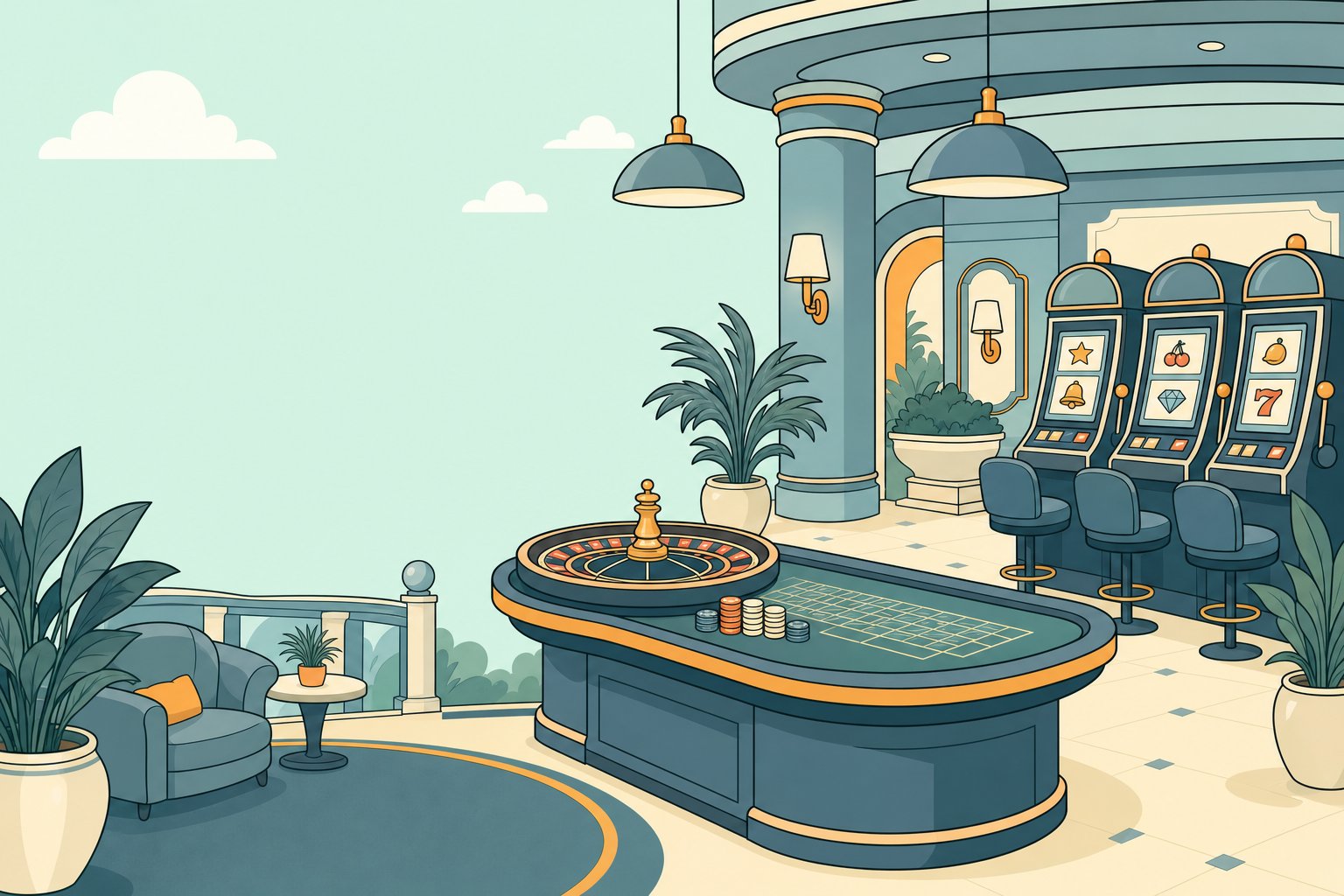
The first thing most people notice walking onto a casino floor is sensory overload, and that’s by design. The lighting, the layered sound of machines and chatter, the temperature, the absence of clocks and windows — all of it is engineered to create a particular mood. Whatever one thinks of that design, the effect is real and it doesn’t travel through a phone.
A live roulette wheel has a sound and a rhythm. Cards have a snap to them. Chips have a weight and a clink when they stack. These are small things individually, but together they make the act of playing feel like an event rather than a tab in a browser. For a lot of people that texture is the entertainment, separate from whether any given bet wins or loses.
The wider Casino Insights section covers how different parts of the floor are put together; the short version is that nearly everything about a physical room is tuned to make staying a little longer feel natural.
The social side: dealers, fellow players, a night out
Online play is, for the most part, solitary. Even live-dealer streams put a pane of glass between the player and everyone else. A physical casino is a social space, and for many visitors that’s the main draw.
There’s the dealer — a person who runs the game, sets the pace, and gives the table a bit of personality. There are the other players at a craps or blackjack table, where strangers end up sharing the swings of a shoe or a hot roll. And there’s the simple fact that going to a casino is usually a night out: people arrive in a group, get dinner, see a show, and treat a couple of hours at the tables as one part of a larger evening rather than the whole point of it.
That social layer is hard to value in numbers, but it’s the reason a lot of people prefer a real table even when the online version is more convenient. Games like table games versus slots feel noticeably different in a room full of people than they do alone.
Comps, loyalty perks and hospitality
Physical casinos compete for visitors with hospitality, and regular players can end up with perks that have no clean online equivalent. Loyalty programs commonly track play and convert it into benefits — these vary widely by venue and tier, but can include things like discounted or complimentary dining, parking, show tickets, room rates for travellers, and similar extras.
It’s worth being clear-eyed about this: comps are a marketing cost the house is happy to pay because it expects to come out ahead overall, and the value returned is typically a small fraction of what a player wagers. They’re a nice bonus, not a reason to play more than planned. But for someone who was going to visit anyway, the hospitality side genuinely adds something — and being recognised and looked after by staff is part of the appeal that online play, by its nature, can’t offer.
The ritual and the pace
One of the underrated differences is speed. Online games — and especially auto-play and fast-forward modes — can run through an enormous number of rounds per hour. A physical table is slower by default. The dealer shuffles, players place bets, cards are dealt, payouts are counted out by hand.
That slower rhythm has two effects. First, it makes the session feel more deliberate; there’s a ritual to it that many players enjoy for its own sake. Second, and more practically, fewer rounds per hour means the house edge has fewer chances to act on a given bankroll over an evening. Pace doesn’t change the odds of any single bet, but it does change how much total money flows across the table in a night — generally in the player’s favour compared with rapid online play.
Live entertainment, dining and the destination
For a lot of visitors the gaming floor is only one room in a much bigger building. Larger venues are built as destinations: restaurants, bars, concerts and shows, sometimes hotels, spas and shopping. The casino is the anchor, but the trip is about the whole package.
This is something online play simply isn’t competing for. A streamed table can deliver a game; it can’t deliver a weekend away, a dinner with friends before the show, or the sense of occasion that comes with getting dressed up and going somewhere. For people who treat a casino visit as a leisure outing rather than a way to place bets, the surrounding experience is most of the value.
Trust and tangibility
There’s a psychological comfort in watching things happen in front of you. You can see the wheel spin, watch the ball drop, see the cards come off the shoe, and hold your chips in your hand. Nothing is hidden behind software.
Reputable online casinos use audited random number generators and are subject to licensing oversight, so the fairness question is well covered in practice — this isn’t really about one format being trustworthy and the other not. It’s about perceived tangibility. For players who find a physical, observable game more reassuring than a digital one, that comfort is a real part of why they prefer the floor, even if the underlying fairness is comparable. Physical chips also create a small, useful friction: handing over cash and stacking chips feels more concrete than tapping a balance, which can make spending easier to track.
Where online genuinely wins
None of this means online play is the lesser option — it’s just optimised for different things, and it’s better at several of them. A fair comparison has to give it full credit:
- Convenience. No travel, no dress code, no waiting for a seat. You can play for five minutes from the sofa.
- Lower minimums. Online stakes often start far below the table minimums on a physical floor, which makes the games far more accessible to casual players.
- Bonuses and promotions. Online operators lean heavily on welcome offers and ongoing promotions. These come with conditions worth reading carefully — our casino bonuses explainer covers how wagering requirements work — but the headline value can be substantial.
- Game variety. A website isn’t limited by floor space, so the catalogue of slots and table variants available online dwarfs what any single physical room can hold.
- Pace control. Online you set the speed — including playing far slower than any dealer would, which keeps total exposure to the edge low.
Land-based vs online at a glance
| Land-based casino | Online casino | |
|---|---|---|
| Atmosphere | Full sensory experience, hard to replicate | Limited; even live-dealer is behind a screen |
| Social side | Dealers, fellow players, a night out | Mostly solitary |
| Convenience | Requires a trip | Play anywhere, anytime |
| Minimum bets | Generally higher | Often very low |
| Bonuses | Limited; mostly comps and loyalty perks | Frequent welcome and ongoing offers |
| Game variety | Constrained by floor space | Very large catalogue |
| Pace | Slower, more deliberate | Player-controlled, can be very fast or very slow |
| Hospitality | Dining, shows, rooms, comps | None of this; just the games |
| House edge | Same as online for the equivalent game | Same as land-based for the equivalent game |
The bottom line in that table is the last row: the odds on a given game don’t favour either format. The choice between them is about what kind of experience you want, not about where you’ll do better.
A note on responsible play
Whichever format appeals more, the underlying maths is the same in both. Every casino game carries a house edge, which means that over time the house is built to come out ahead — there’s no version, online or in person, where that stops being true. No article can responsibly promise winnings, and this one doesn’t.
The sensible approach is the same everywhere: set a budget before you start, treat it as the cost of an evening’s entertainment rather than an investment, and decide in advance when to stop. The atmosphere, the company and the night out are the things a land-based casino offers that a screen can’t — and they’re worth enjoying on their own terms, with the betting kept firmly inside a limit you set deliberately. If gambling stops being fun or starts feeling like a way to make money, that’s the cue to step back and seek support.
Frequently asked questions
Are the odds better at a land-based casino than online?
No. For the equivalent game, the house edge is the same whether you play in person or online. The difference between the two formats is the experience, the pace and the surrounding extras — not the underlying odds.
What can a land-based casino offer that online can't?
The full sensory atmosphere of the floor, the social side of real dealers and fellow players, hospitality like dining and shows, physical chips you can hold, and the sense of a night out. These are experiential things a screen can't reproduce.
Is online play cheaper to get started with?
Usually, yes. Online minimum bets often start well below the table minimums on a physical floor, which makes the games more accessible for casual or low-stakes players.
Are casino comps and loyalty perks actually worth it?
They're a genuine nice-to-have for someone who was visiting anyway, but they're a marketing cost the house expects to recover. The value returned is typically a small fraction of what a player wagers, so comps are a bonus, not a reason to play more than planned.
Does the slower pace of a physical table matter?
It can. A slower pace means fewer rounds per hour, so the house edge has fewer chances to act on a given bankroll over an evening. It doesn't change the odds of any single bet, but it does affect how much money flows across the table in a night.
Is online gambling safe and fair?
Reputable, licensed online casinos use audited random number generators and are subject to regulatory oversight, so fairness is well covered in practice. The preference for a physical game is usually about perceived tangibility rather than a real fairness gap.
Why do online casinos offer so many more games?
A website isn't limited by physical floor space, so it can list a far larger catalogue of slots and table variants than any single room can hold. Variety is one of the clearest advantages of online play.
How should I set a budget for a casino visit?
Decide before you start how much you're comfortable spending, treat it as the cost of entertainment rather than an investment, and set a point at which you'll stop. The same approach applies online and in person, because the house edge exists in both.
Which format is better overall?
Neither is universally better — they're suited to different things. Online wins on convenience, low minimums, bonuses and game variety; a land-based casino wins on atmosphere, the social side and hospitality. The right choice depends on the experience you're after.